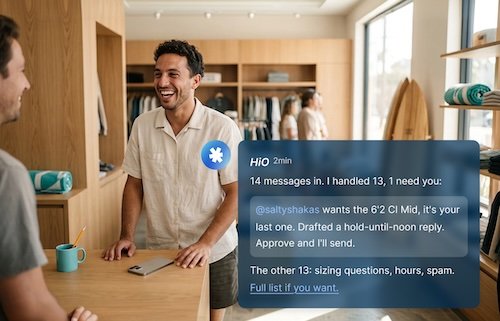


Quick answer: Small businesses use AI to get more customers by automating the three things that most directly affect sales but eat the most time: responding to customer messages instantly, catching buying patterns and opportunities the owner would otherwise miss, and keeping marketing (social, email, promotions) running consistently. None of this requires a new hire. It requires connecting AI to the accounts a business already uses, a storefront, an inbox, a social account, and letting it handle the repeatable work while the owner approves anything that goes out.
Small business AI adoption backs this up: 68% of small businesses using AI apply it to marketing content creation, 52% to customer communication, and 47% to administrative tasks, according to 2026 data. The businesses doing this well aren't hiring more people to run it. They're using AI to do the work a new hire would have done.
In this guide: Step 1: Answer Instantly · Step 2: Spot Opportunities · Step 3: Automate Social · Step 4: Email & Win-Back · Step 5: Reviews · Step 6: Track Results · Cost vs. Hiring · Tools to Do This · FAQ
Want the one-tool version of steps 1 through 4? See how HiO does it from a single connected system →
Step 1: Answer Every Customer Message Instantly
The single biggest lever for customer acquisition that most small businesses underuse is response time. A missed DM, comment, or email is a lost sale, not just a missed conversation. Missed calls and messages during peak hours are one of the most expensive quiet costs in small businesses, particularly for service businesses like salons, gyms, and home service contractors, where a slow reply often means the customer books somewhere else.
How to do this with AI, no hiring required:
- Connect an AI tool directly to the channels customers actually use (Instagram, WhatsApp, email, SMS), not just one.
- Use a tool that reads real business data (inventory, availability, pricing) so it can answer specifically, "yes, that's in stock" or "yes, Friday at 2pm is open", rather than a generic "someone will get back to you."
- Set a clear rule for what gets auto-answered versus flagged for a human: routine questions (pricing, hours, stock) can go out immediately; anything sensitive, a complaint, a personal situation, gets handed back.
46% of small businesses already use AI-powered customer engagement tools like this. The ones getting the most from it are answering across every channel a customer might use, not just the one that's easiest to automate.
Step 2: Let AI Spot the Sales Opportunities You're Too Busy to Notice
Most small business owners are in the day-to-day of the business: on the floor, in session, packing orders, which means the patterns that turn into new sales (a product mentioned five times in comments this week, a regular who hasn't ordered in two months, a review that's actually a lead) go unnoticed.
What this looks like in practice:
- A repeated question ("do you ship to Canada?") across a dozen messages is a sign to add a shipping FAQ, or a sign there's real demand for a new option.
- A product selling out repeatedly in DMs is a signal worth turning into a restock announcement or a waitlist.
- A customer who used to order monthly and has gone quiet for two months is a win-back opportunity, not a lost cause, if someone reaches out before they forget the business exists.
AI that's connected to a business's actual sales and messaging data can surface these automatically instead of requiring the owner to notice them while also running the business. This is the core difference between AI used only for customer service and AI used as a genuine growth lever: the second kind treats every conversation as a data point, not just a task to close out.
Step 3: Automate Social Content Without Losing Your Voice
Marketing content creation is the single most common AI use case among small businesses, at 68% adoption. The failure mode isn't a lack of AI tools, it's generic output that doesn't sound like the business, or a content calendar that gets abandoned after two weeks because nobody has time to keep feeding it.
How to avoid generic AI content:
- Use a tool that reads what's actually been posted before and what's gotten engagement, rather than generating from a blank prompt every time.
- Ground posts in real business events (a new product, a customer story, a slow week that's actually worth a promotion) instead of generic "5 tips" content.
- Keep a human approval step. AI can draft the calendar and the captions; a 30-second review before anything goes live keeps the brand voice intact.
Step 4: Use AI for Email and Win-Back Campaigns
Email remains one of the highest-ROI channels for small businesses, but it's also one of the first things to get skipped when time is short. AI closes this gap by drafting the campaign the moment there's a reason to send one, a slow week, a new product, a subscriber list that's grown but never received a welcome sequence, rather than waiting for someone to have a free afternoon.
Practical starting points:
- A welcome sequence for new subscribers who've never gotten one.
- A win-back email for customers who haven't ordered or booked in a set window (60 to 90 days is a common trigger point).
- A restock or new-arrival announcement tied to real inventory changes, not a fixed calendar.
Step 5: Let AI Handle Reviews and Reputation
Review responses are a customer acquisition tool, not just a service task; prospective customers read them before they book or buy. AI can draft a response to a review, positive or negative, the same day it's posted, matching the tone the situation calls for (a complaint gets patience, a compliment gets warmth), with the owner approving before it's posted.
Step 6: Track What's Actually Working
AI adoption without measurement is how businesses end up with five tools and no clear read on ROI, a pattern 2026 data confirms: the average AI-using small business runs a median of five tools, but 77% report no formal strategy for how they're used. Before adding another tool, track:
- Response time to customer messages, before and after automating replies.
- Conversion on flagged opportunities, restock alerts, win-back emails, promo suggestions, did they turn into sales?
- Time saved per week, small businesses using AI report saving 5.6 hours per week on average, and that time should be reinvested in the parts of the business only the owner can do.
What This Costs vs. Hiring
Part-time customer service hire
- Typical monthly cost: $1,500 to $3,000+
- Coverage: Business hours only
- Ramp-up time: Weeks of hiring and training
- Consistency: Varies with turnover
Social media manager (contractor)
- Typical monthly cost: $500 to $2,000+
- Coverage: Scheduled posts, limited real-time response
- Ramp-up time: Weeks of onboarding to brand voice
- Consistency: Varies with contractor availability
AI business partner covering both
- Typical monthly cost: Single subscription, generally a fraction of either hire
- Coverage: 24/7 message coverage plus ongoing content
- Ramp-up time: Connects to existing accounts, live in days
- Consistency: Consistent once set up, improves with use
This isn't an argument that AI replaces every hire, judgment calls, in-person service, and complex problem-solving still need a person. It's specifically the repeatable, always-on work (answering messages, catching patterns, drafting content) that AI can absorb without adding payroll.
Tools to Do This
Getting more customers with AI without hiring anyone generally means combining a few categories:
- An AI business partner, like HiO, that connects to a business's existing accounts and handles customer replies, opportunity-spotting, and marketing from one place, everything in Steps 1 through 4 above, from a single system instead of four separate ones.
- A design tool (like Canva) for visual content production.
- Basic automation (like Zapier) if data needs to move between separate systems.
The fewer separate logins required to run this, the more likely it actually gets used consistently, which is the real determinant of whether AI turns into more customers or just another subscription.
"The every day anxiety that comes with being the owner of a small business is not being able to get it all done. HiO alleviates stressors and allows me to focus on things that really matter for growing the business."
— Heidi, Owner, Kingdom Come Home
See what this looks like for your business. Connect your accounts and HiO gets to work the same day. Get started for free →
Frequently Asked Questions
Can AI actually get me more customers, or just save time?
Both, and they're connected. 91% of small businesses using AI report a revenue increase, largely because faster response times and consistent marketing directly convert into more bookings and sales, not just efficiency gains.
How quickly can a small business see results from using AI this way?
Response-time improvements are immediate, once connected, AI answers as fast as a message arrives. Marketing and opportunity-spotting gains typically show up over 4 to 8 weeks as patterns accumulate and campaigns run.
Do I need to hire someone to manage the AI tools?
No. Tools built for small business owners are designed for the owner to set up and approve, not to require a dedicated AI manager. The approval step (reviewing replies, posts, and campaigns before they go out) takes minutes a day, not a new role.
What's the biggest mistake small businesses make when using AI to get more customers?
Spreading across too many single-purpose tools without a strategy. The data shows the average AI-using small business runs five separate tools with no formal system for using them, which dilutes the time savings and makes it hard to see what's actually working.
Is it safe to connect my customer and sales data to an AI tool?
Reputable providers use business data only to serve that business and its customers, and don't sell, share, or post on the owner's behalf without approval. Confirm this directly in any provider's terms before connecting accounts.
What size business is this actually realistic for?
This applies most directly to businesses with 0 to 19 employees, solo operators up through small teams, where the owner is doing most of the customer-facing and marketing work themselves and doesn't have the budget for multiple dedicated hires.
Ready to get started? HiO handles the customer replies, the opportunity-spotting, and the marketing, so you don't have to hire for any of it. Get started for free →
Sources: SBE Council, "Success Strategies: The AI Tools Small Businesses Are Using," 2026; Capsule CRM, "Small Business AI Adoption Statistics for 2026"
